The Big Question
What happens when a region goes down and your entire application goes with it? When your disaster recovery plan says "fail over to the secondary region" but the secondary region was never properly tested or worse, was never built because duplicating everything would double your cloud bill?
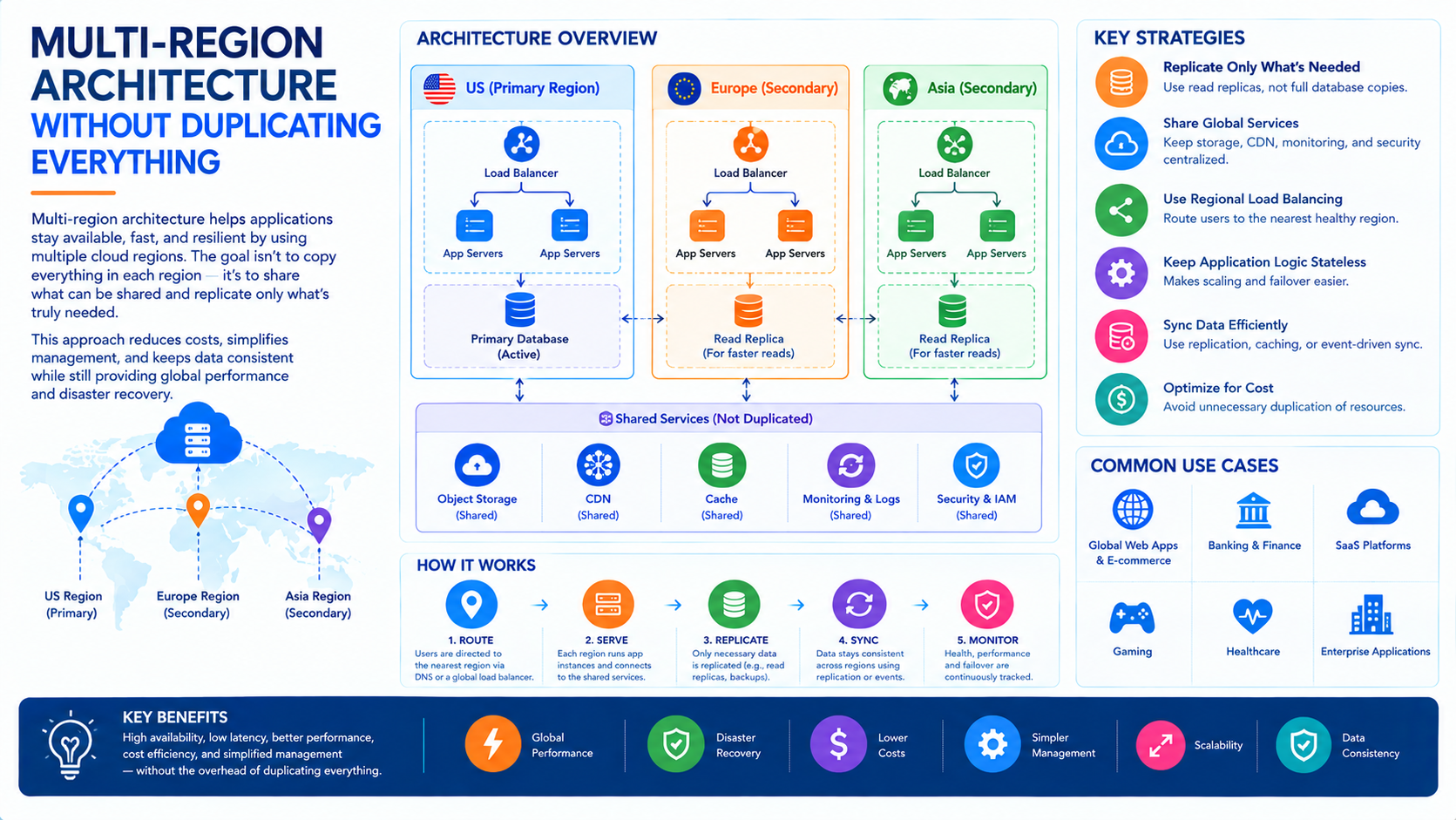
This is the fundamental tension in multi-region design. Resilience requires redundancy, but redundancy is expensive. The naive answer replicate everything everywhere solves availability and destroys your budget. The better answer is to understand what actually needs to survive, what can be rebuilt, and what can tolerate a few minutes of downtime.
The Duplication Trap
The default mental model for disaster recovery is "keep a copy of everything." For organizations moving from single-region to multi-region, this instinct leads to a predictable outcome: infrastructure costs double, operational complexity multiplies, and the team spends more time maintaining the replica than building product.
The duplication trap has three costs:
Infrastructure cost: Every service, database, cache, queue, and storage bucket that is replicated into a second region is billed twice.
Operational cost: Two copies of everything means two things to patch, monitor, upgrade, and debug. Configuration drift between regions becomes a permanent source of incidents.
Cognitive cost: Engineers must reason about two environments instead of one, which slows every design conversation and every deployment.
The goal of modern multi-region architecture is to break this equation. Resilience and full duplication are not the same thing.
The Core Principle: Classify by Recovery Requirement
Before designing anything, classify every component by what it actually requires to survive a regional failure.
| Tier | Requirement | Design Approach |
|---|---|---|
| Tier 1: Must survive instantly | Zero or near-zero data loss; sub-minute recovery | Actively replicated across regions; serves traffic from multiple regions |
| Tier 2: Must survive quickly | Minutes of data loss acceptable; recovery in minutes to hours | Asynchronously replicated; standby capacity kept warm but not fully provisioned |
| Tier 3: Can be rebuilt | Data loss acceptable; recovery in hours | Backed up and reconstructed on demand in the surviving region |
| Tier 4:Region-local | No cross-region requirement at all | Not replicated; unavailable during a failure, by design |
The critical insight is that most systems are a mix. A payments ledger is Tier 1. An analytics warehouse is Tier 3. A batch reporting job is Tier 4. Treating all of them the same is what causes unnecessary cost.
Pattern 1: Stateless Services — Deploy, Don't Duplicate
Stateless services API gateways, request handlers, background workers are the easiest to make multi-region because they hold no data. The pattern here is not duplication but identical deployment.
Deploy the same container image into multiple regions using the same Infrastructure as Code. Route traffic to the nearest healthy region using global load balancing or DNS-based routing. When a region fails, the global router simply stops sending traffic there.
Because the service holds no state, there is nothing to replicate. The cost of a second region is the cost of idle compute which can often be kept at a low baseline and scaled up only during a failover event.
Key controls:
-
Single image, multiple regions
-
Global load balancing with health checks
-
Autoscaling that can absorb the failed region's traffic
-
Identical configuration managed through IaC, never manual
Pattern 2: Data - Replicate Selectively, Not Universally
Data is where duplication becomes expensive. Not all data needs to be in all regions, and not all of it needs to be there at the same consistency level.
Tier 1 Data: Active-Active Replication
For data that must never be lost and must be available instantly financial ledgers, authentication state, critical customer records use databases that support multi-region active-active replication. These systems replicate writes synchronously or near-synchronously across regions and resolve conflicts deterministically.
Trade-offs: Higher write latency due to cross-region coordination, and significant cost. Reserve this tier for the small subset of data that truly requires it.
Tier 2 Data: Asynchronous Replication with Warm Standby
For most business data, asynchronous replication to a standby region is sufficient. Writes go to the primary region and replicate to the secondary within seconds. During a failure, the secondary is promoted and applications reconnect.
Trade-offs: Some data loss during failover (bounded by replication lag), and failover takes minutes rather than seconds. This is acceptable for the majority of workloads.
Tier 3 Data: Backup and Restore
For data that can tolerate hours of recovery time analytics, historical records, logs use cross-region backups. The data exists in the secondary region only as a backup, not as a live replica. Restoring it is a deliberate, tested procedure.
Trade-offs: Longer recovery time, but dramatically lower cost. No always-on replication infrastructure.
Tier 4 Data: Region-Local
Some data genuinely does not need to leave its region. Regional analytics, local caches, and ephemeral state can be left region-local by design, accepting unavailability during a regional failure.
The key discipline: Every dataset must be explicitly assigned to a tier. Ambiguity is what causes accidental duplication.
Pattern 3: The "Thin Secondary" Approach
A powerful middle ground between "duplicate everything" and "backup only" is the thin secondary region. In this model, the secondary region runs only the minimum infrastructure required to take over, while the rest is provisioned on demand.
How it works:
-
Tier 1 data is actively replicated into the secondary region.
-
Core services (authentication, API gateway, critical request handlers) run at a low baseline capacity.
-
Everything else analytics engines, batch workers, reporting services is defined in Infrastructure as Code but not running.
-
During a failover, automation provisions the dormant infrastructure in the secondary region and scales the baseline services up.
The result: You pay for the resources that must exist at all times, and you pay for the rest only when you need them. Infrastructure as Code makes the reconstruction fast and deterministic.
Pattern 4: Regional Cells with a Global Control Plane
For larger systems, a cell-based architecture isolates failure domains while avoiding full duplication. The system is divided into cells each cell is a self-contained unit serving a subset of users. A global control plane routes users to their assigned cell and manages cross-cell concerns like authentication and billing.
When a cell fails, only the users assigned to that cell are affected. Recovery can involve reconstructing that cell in another region rather than failing over an entire application.
The advantage: Failures are contained, and the blast radius is bounded by design rather than by accident.
Pattern 5: Global Services for Cross-Cutting Concerns
Some concerns are better handled globally than replicated regionally. Identity, DNS, secrets management, and observability can often run as global services that all regions consume, rather than being independently deployed per region.
This reduces duplication for components that do not benefit from regional isolation and centralizes the operational burden for services that are inherently global.
What Must Be Tested
Multi-region architecture is only as good as its tested failover. The most common failure mode is a plan that has never been executed.
Test at minimum:
-
Promote the standby database and verify application connectivity
-
Route traffic to the secondary region and confirm correctness
-
Provision dormant infrastructure from IaC and measure the time taken
-
Fail back to the primary region cleanly
-
Verify monitoring and alerting work in both regions
Cadence: Test Tier 1 failover quarterly. Test Tier 2 and Tier 3 recovery at least twice a year. Document actual recovery times—they will differ from your targets.
Implementation Roadmap
Phase 1: Classify and Document (Weeks 1-4)
-
Inventory every component. Services, databases, queues, caches, storage, and third-party dependencies.
-
Assign each to a tier. Tier 1 through Tier 4 based on recovery requirement.
-
Document recovery targets. RTO and RPO per tier, signed off by the business.
-
Identify the minimum viable secondary. What must exist at all times versus what can be provisioned.
Phase 2: Build the Foundation (Weeks 5-8)
-
Codify everything in IaC. Both regions must be deployable from the same templates.
-
Implement global routing with health checks and failover logic.
-
Deploy Tier 1 replication across regions.
-
Establish Tier 2 replication with monitoring on replication lag.
Phase 3: Test and Refine (Weeks 9-12+)
-
Run a Tier 1 failover test. Measure actual RTO and RPO.
-
Test Tier 2 promotion. Verify data integrity after failover.
-
Test reconstruction of Tier 3 and Tier 4 components from IaC and backups.
-
Test failback. Returning to the primary region is often harder than the failover.
-
Refine automation based on measured timings.
Frequently Asked Questions
Q1: Do I need multi-region architecture?
Not necessarily. Single-region with multi-availability-zone deployment survives most failures. Multi-region is warranted when a regional outage would cause unacceptable business impact, or when regulatory requirements demand geographic redundancy.
Q2: What is the cheapest way to achieve multi-region resilience?
The cheapest viable approach is Tier 1 active replication for critical data, Tier 2 asynchronous standby for most services, and Tier 3 backups for everything else combined with Infrastructure as Code that allows dormant infrastructure to be provisioned on demand.
Q3: How do I avoid data conflicts in active-active replication?
Choose databases with proven conflict resolution (last-write-wins with vector clocks, CRDTs, or region-scoped writes). Partition data by region where possible so that writes for a given entity are always directed to a single region.
Q4: How often should I test failover?
Tier 1 failover should be tested at least quarterly. Tier 2 and Tier 3 recovery should be tested at least twice a year. Untested failover plans are documentation, not capability.
Q5: Isn't provisioning infrastructure during a failover too slow?
It depends on the tier. Tier 1 and Tier 2 components must be running or warm at all times. Tier 3 and Tier 4 components can be provisioned on demand if their recovery time target allows it. The tiering framework exists precisely to make this trade-off explicit.
Q6: How can Innovative AI Solutions help?
We help organizations design, build, and operationalize multi-region architectures from component classification and tiering to replication design, failover automation, and testing. Based in Delhi, serving clients across India.
Why Delhi is a Great Hub for Cloud Architecture Innovation
Delhi is emerging as a hub for cloud-native and enterprise architecture innovation, backed by a thriving IT services ecosystem and global delivery centers. As Indian enterprises expand their digital footprints across geographies and face increasing regulatory expectations around resilience, disciplined multi-region architecture becomes a competitive advantage.
What We Offer at Innovative AI Solutions
-
Multi-Region Strategy: We help you classify components and design a tiered resilience architecture.
-
Infrastructure as Code: We codify both regions from a single source of truth.
-
Replication Design: We implement Tier 1 and Tier 2 replication with tested failover.
-
Failover Automation: We build and test the procedures that make recovery real.
-
Cost Optimization: We help you avoid unnecessary duplication while meeting recovery targets.
Final Thought
The shift is clear: from duplicating everything to replicating deliberately. Multi-region architecture is not about having two of everything it is about knowing what must survive, what can be rebuilt, and what can wait. Organizations that master this discipline will achieve resilience without paying for redundancy they do not need.
Contact Us:
Phone: +91 7464 099 059 / +91 9689967356
Email: info@innovativeais.com
Address: 904, 9th floor Pearls Best Heights-I, Netaji Subhash Place, Delhi-110034
Website: https://innovativeais.com
About the Author
Abhishek Kumar
Founder & CEO, Innovative AI Solutions
5+ years building AI, cloud, and enterprise systems. Based in Delhi, serving clients across India.