The Big Question
What happens when your application needs to show live data a chat message, a price change, a collaborative edit, a system alert but your only tool is asking the server repeatedly if anything has changed? Polling works, but it is fundamentally wasteful. Most requests return nothing new. The server carries load for questions with no answers. Latency is bounded by the polling interval, not by how quickly the event occurred.
For years, polling was the only option available to most developers. That is no longer true. A mature set of push-based technologies now makes real-time communication practical in production.
Why Polling Is the Wrong Default
Polling comes in two common forms:
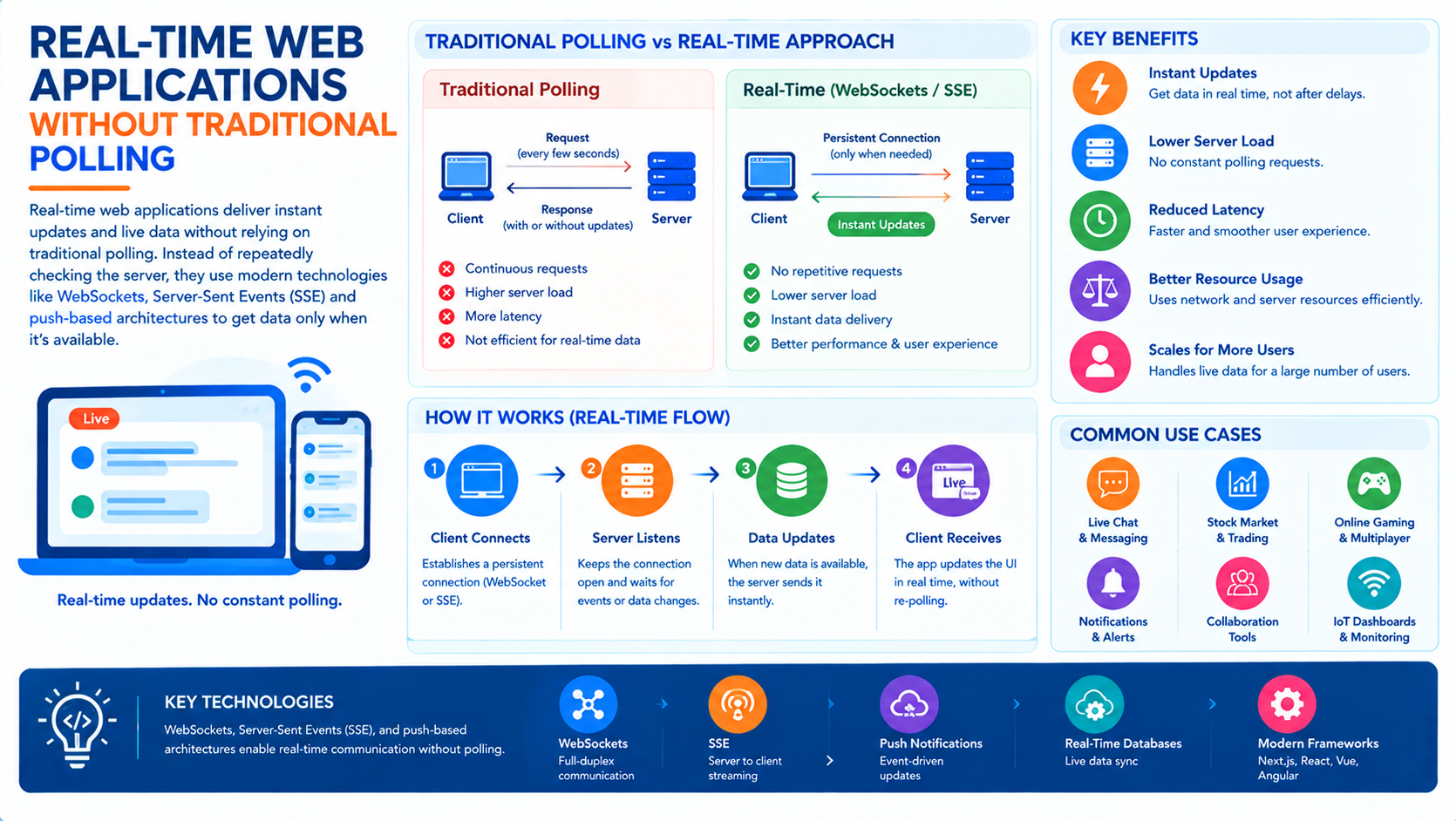
Short polling: The client sends a request every N seconds. Most responses are empty. Latency averages half the polling interval. Server load scales with the number of clients multiplied by the polling frequency.
Long polling: The client sends a request and the server holds it open until there is something to return (or a timeout occurs). This reduces empty responses but still requires the client to re-establish a connection after every message, and it consumes a server connection per waiting client.
Both approaches treat the server as a passive responder and the client as the initiator. Both introduce unnecessary latency and load. Both are workarounds for a problem that push-based protocols solve directly.
The Push-Based Alternatives
WebSockets
WebSockets provide a full-duplex, persistent connection over a single TCP connection. Once established, both client and server can send messages at any time with minimal framing overhead.
Best for: Chat, multiplayer collaboration, gaming, live dashboards, trading systems any application where both sides need to send messages frequently and with low latency.
Considerations: WebSockets bypass some HTTP semantics, which can complicate proxies, load balancers, and security inspection. Connection management (heartbeats, reconnection, backpressure) must be handled explicitly. Scaling requires a shared pub/sub layer (such as Redis) so that messages reach the correct server instance.
Server-Sent Events (SSE)
Server-Sent Events provide a one-way stream from server to client over a standard HTTP connection. The client subscribes, and the server pushes a stream of text events until the connection closes. Reconnection is handled automatically by the browser.
Best for: Live feeds, notifications, progress updates, stock tickers, log streaming cases where the server pushes information and the client rarely needs to send anything back.
Considerations: SSE is unidirectional. For bidirectional communication, the client must use a separate HTTP request. Over HTTP/1.1, browsers limit the number of concurrent connections per domain, which constrains how many SSE streams a single page can open. This limitation largely disappears with HTTP/2 and HTTP/3.
HTTP/2 and HTTP/3 Streaming
HTTP/2 and HTTP/3 support multiplexed streams over a single connection and allow the server to push data as part of a response stream. Combined with SSE, this eliminates the connection-per-stream limitation of HTTP/1.1 and makes server-sent streaming practical at scale.
HTTP/3, built on QUIC, adds further improvements: faster connection establishment, better behavior on unreliable networks, and no head-of-line blocking at the transport layer. For mobile clients on variable networks, this can meaningfully improve real-time reliability.
WebTransport
WebTransport is a newer protocol built on HTTP/3 and QUIC that provides both reliable streams and unreliable datagrams to the browser. It is designed for low-latency applications that need more flexibility than WebSockets offer such as cloud gaming, live video, and high-frequency data feeds where some message loss is acceptable in exchange for lower latency.
Best for: Applications where latency matters more than guaranteed delivery, or where multiple independent streams are needed.
Considerations: Browser support is still maturing, and it requires HTTP/3 infrastructure.
Comparison at a Glance
| Technology | Direction | Transport | Best For | Maturity |
|---|---|---|---|---|
| Short Polling | Client → Server | HTTP | Simple, infrequent updates | Universal |
| Long Polling | Client → Server (held) | HTTP | Legacy compatibility | Universal |
| Server-Sent Events | Server → Client | HTTP/1.1, HTTP/2, HTTP/3 | Feeds, notifications, streaming | Broad |
| WebSockets | Bidirectional | TCP (upgrade from HTTP) | Chat, collaboration, gaming | Very broad |
| WebTransport | Bidirectional + datagrams | HTTP/3 (QUIC) | Low-latency, loss-tolerant workloads | Emerging |
Choosing the Right Approach
Start with the data flow. If the server pushes and the client rarely sends, SSE is often the simplest correct answer. If both sides send frequently, WebSockets are the natural fit.
Consider your infrastructure. WebSockets require load balancers and proxies that support connection upgrades and long-lived connections. SSE works over standard HTTP and is generally simpler to operate, especially with HTTP/2.
Consider your clients. Mobile clients on unreliable networks benefit from HTTP/3 and QUIC-based transports. Browser clients have broad support for WebSockets and SSE, while WebTransport support continues to expand.
Consider scale. All push-based approaches require a shared pub/sub layer when running multiple server instances. Without it, a message published on one instance will not reach clients connected to another.
Consider fallback. In constrained environments corporate proxies, legacy networks a fallback path may still be necessary. Design the abstraction so the transport can change without rewriting application logic.
Production Considerations
Connection Management
Persistent connections must be monitored and maintained:
-
Heartbeats: Periodic messages to detect dead connections
-
Reconnection: Exponential backoff with jitter to avoid thundering herds
-
State resumption: The ability to resume a stream from where it left off (SSE supports Last-Event-ID for this)
Backpressure
A slow client must not consume unbounded server memory. Applications must handle backpressure by buffering, dropping, or disconnecting slow consumers based on the use case.
Authentication and Authorization
Persistent connections are long-lived, which means authorization decisions made at connection time may become stale. Systems should support revalidation, revocation, and per-message authorization where appropriate.
Observability
Track connection counts, message rates, latency distributions, error rates, and reconnection frequency. Real-time systems fail in ways that batch systems do not, and observability is what makes those failures visible.
Scaling
When running multiple server instances, use a shared message broker (Redis Pub/Sub, NATS, Kafka) to distribute events across instances. Sticky sessions are an alternative but limit scaling flexibility.
Implementation Roadmap
Phase 1: Assess (Weeks 1-2)
-
Map your real-time requirements. Identify which features need live updates and how quickly.
-
Determine directionality. Is communication server-to-client, client-to-server, or both?
-
Assess infrastructure constraints. Do your load balancers, proxies, and CDN support persistent connections?
Phase 2: Implement (Weeks 3-5)
-
Choose a transport based on the comparison above.
-
Abstract the transport layer so it can be swapped without rewriting business logic.
-
Implement connection lifecycle heartbeats, reconnection, and state resumption.
-
Add a shared pub/sub layer if running multiple instances.
Phase 3: Harden (Weeks 6-8)
-
Implement backpressure handling.
-
Add observability for connection counts, message rates, and latency.
-
Test failure modes network interruption, server restart, slow clients.
-
Plan fallbacks for constrained environments.
Frequently Asked Questions
Q1: Is polling ever the right choice?
Yes, in narrow cases: when updates are infrequent, when the environment blocks persistent connections, or when the simplicity of polling outweighs its inefficiency. But for genuinely real-time features, polling is a workaround rather than a solution.
Q2: When should I use SSE instead of WebSockets?
Use SSE when the server pushes information and the client rarely needs to send messages live feeds, notifications, progress updates. Use WebSockets when both sides need to send frequently.
Q3: Do WebSockets work through load balancers and CDNs?
Generally yes, but they require support for HTTP upgrade and long-lived connections. Configuration varies by provider and should be tested explicitly.
Q4: What is WebTransport and do I need it?
WebTransport is a QUIC-based protocol offering reliable streams and unreliable datagrams. It is valuable for latency-sensitive, loss-tolerant applications like cloud gaming and live video. Most applications do not need it yet, but it is worth monitoring.
Q5: How do I scale real-time applications across multiple servers?
Use a shared pub/sub layer (Redis Pub/Sub, NATS, Kafka) so events published on one instance reach clients connected to others. Sticky sessions are an alternative but reduce flexibility.
Q6: How can Innovative AI Solutions help?
We help organizations design and implement real-time web architectures from transport selection and connection management to scaling, observability, and fallback design. Based in Delhi, serving clients across India.
Why Delhi is a Great Hub for Real-Time Web Innovation
Delhi is emerging as a hub for web and enterprise application innovation, backed by a thriving developer ecosystem and growing demand for real-time experiences in fintech, logistics, and customer engagement. As Indian enterprises build applications that require live data and instant feedback, understanding push-based architectures becomes essential.
What We Offer at Innovative AI Solutions
-
Real-Time Architecture Strategy: We help you choose the right transport for each use case.
-
Implementation: We build WebSocket, SSE, and HTTP streaming systems with proper connection lifecycle management.
-
Scaling: We implement shared pub/sub layers and connection distribution.
-
Observability: We instrument connection health, message rates, and latency.
-
Fallback Design: We build resilient paths for constrained environments.
Final Thought
The shift is clear: from asking the server repeatedly to having the server tell you. Polling was a necessary compromise in an era without better options. Push-based technologies WebSockets, SSE, HTTP/2 and HTTP/3 streaming, and WebTransport now make genuine real-time communication practical. The organizations that adopt them will deliver faster, more responsive, and more efficient applications.
Contact Us:
Phone: +91 7464 099 059 / +91 9689967356
Email: info@innovativeais.com
Address: 904, 9th floor Pearls Best Heights-I, Netaji Subhash Place, Delhi-110034
Website: https://innovativeais.com
About the Author
Abhishek Kumar
Founder & CEO, Innovative AI Solutions
5+ years building AI, cloud, and enterprise systems. Based in Delhi, serving clients across India.