The Big Question
What happens when you need to deploy a new service in ten minutes but your platform team has a two-week backlog? When your workload is spiky and unpredictable, but you're paying for idle compute? When you need both the control of Kubernetes and the simplicity of serverless?
The choice between Serverless and Kubernetes has significant implications for development speed, operational overhead, cost structure, and team autonomy. There is no single right answer only the right answer for your specific context.
What Are Serverless and Kubernetes?
Serverless Architecture
Serverless computing, also known as Function-as-a-Service (FaaS), abstracts away the entire infrastructure layer. You simply deploy your code (in the form of functions) that execute in response to events, without managing any servers .
Key characteristics:
-
Fully managed: No infrastructure management; the cloud provider handles all provisioning, scaling, and maintenance
-
Event-driven: Functions execute in response to events and scale automatically
-
Pay-per-use: You pay only for actual compute time used, down to the millisecond
-
Stateless: Functions should be stateless, with state stored in external services
-
Cold-start latency: Functions can have initial latency as resources are allocated
Kubernetes Architecture
Kubernetes is an open-source container orchestration platform that automates deployment, scaling, and management of containerized applications . It provides control over container placement, scaling, and service discovery.
Key characteristics:
-
Control and flexibility: Complete control over infrastructure and deployment configurations
-
Portability: Consistent environment across cloud providers, on-prem, and hybrid setups
-
Cost-efficiency at scale: Efficient resource utilization with predictable costs at high usage
-
Operational complexity: Requires expertise in cluster management, configuration, and maintenance
-
Stateful applications: Built-in support for stateful services with persistent storage
Side-by-Side Comparison
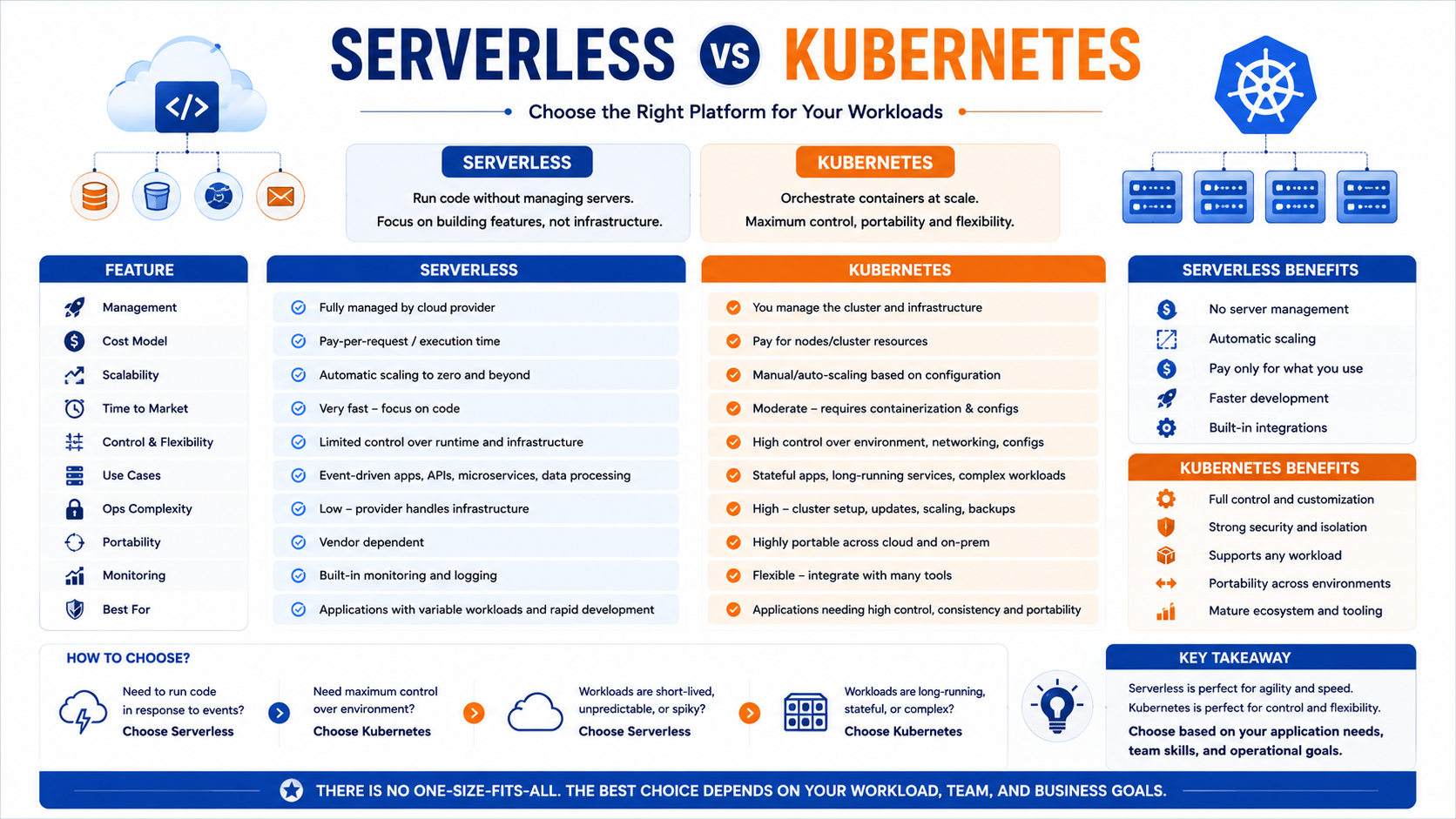
| Aspect | Serverless (FaaS) | Kubernetes (Container Orchestration) |
|---|---|---|
| Operational Model | Fully managed by cloud provider | Self-managed (or partially managed) |
| Resource Configuration | Provider-defined, often limited | Complete control |
| Scaling Unit | Function instance (event-driven) | Pod (can be event-driven with KEDA) |
| Scaling Speed | Milliseconds to seconds | Seconds to minutes |
| Pricing Model | Pay-per-request and compute time | Pay for provisioned resources (instances) |
| State Management | Stateless; use external services | Supports stateful and stateless |
| Cold-Start Latency | Yes | No |
| Operational Overhead | Minimal | Significant |
| Portability | Vendor-specific APIs, limited | High portability across environments |
| Cost at Low Usage | Very low (pay only for used time) | Higher (pay for provisioned resources) |
| Cost at High Usage | Can become expensive for sustained load | More cost-efficient at sustained volume |
| Configuration Complexity | Low (function code only) | High (YAML, networking, storage, security) |
When to Use Serverless
Serverless is the right choice when the goal is to maximize developer velocity, minimize operational overhead, and leverage automatic scaling without managing infrastructure.
Ideal Workloads
Event-Driven Workloads: Applications triggered by events HTTP requests, message queue events, file uploads, database changes, scheduled tasks. Serverless functions are designed for this model.
Sporadic Workloads: Services with low or unpredictable traffic APIs with variable load, proof-of-concept projects, microservices with low usage benefit from pay-per-use economics.
Short-Lived Tasks: Processes that run for seconds or minutes image processing, log parsing, ETL jobs are excellent candidates for serverless.
Rapid Prototyping: When speed matters more than infrastructure control, serverless lets teams focus on code.
Serverless Pain Points
Cold Starts: The delay when a new function instance spins up can be noticeable for latency-sensitive applications. Solutions include keep-warm strategies and provisioned concurrency.
Vendor Lock-in: Serverless APIs are proprietary. Migrating to another provider requires rewriting significant portions of your application.
Stateless Limitations: Serverless functions are expected to be stateless, requiring external storage for state, which adds complexity and latency.
Configuration Limits: Serverless platforms impose resource limits (memory, execution time, concurrent executions) that may constrain advanced use cases.
Debugging Complexity: The distributed nature of serverless applications and limited visibility can make debugging more difficult.
When to Use Kubernetes
Kubernetes is the right choice when you need control, portability, and the ability to run complex, stateful workloads reliably.
Ideal Workloads
Stateful Applications: Databases, caching layers, and other stateful systems that require persistent storage. Kubernetes provides StatefulSets and persistent volume claims for stateful workloads.
Long-Running Microservices: Services with sustained traffic where operational efficiencies and granular configurations are needed.
Complex Applications: Systems with multiple interacting components requiring advanced networking, service discovery, and load balancing.
AI/ML Workloads: Training and inference often require specific hardware accelerators (GPUs) and controlled scaling that Kubernetes supports well.
Hybrid and Multi-Cloud: Workloads that need to run consistently across multiple clouds or on-premises benefit from Kubernetes portability.
Enterprise Platform: Organizations building internal developer platforms often use Kubernetes as the underlying orchestration engine for its extensive ecosystem.
Kubernetes Pain Points
Operational Overhead: Managing a Kubernetes cluster is complex. It demands expertise in networking, storage, security, and ongoing maintenance. Managed Kubernetes services (EKS, AKS, GKE) reduce this overhead but don't eliminate it.
YAML Complexity: Declaring infrastructure requires managing extensive YAML manifests for deployments, services, ingress, config maps, secrets, and custom resources.
Cost at Low Usage: While cost-efficient at scale, Kubernetes clusters require a baseline of resources (control plane nodes) and operational tooling that must be paid for regardless of workload.
Security Complexity: Securing a Kubernetes cluster involves multiple layers authentication, authorization (RBAC), network policies, pod security, secrets management, image scanning, and vulnerability management.
The Convergence Trend
The market is moving toward convergence, not divergence. Providers are building "serverless Kubernetes" (e.g., EKS on Fargate, AKS with virtual nodes, GKE Autopilot) that abstract cluster management while providing the Kubernetes API. This suggests a future where organizations get the portability and ecosystem of Kubernetes with the operational simplicity of serverless .
The architectural insight: The decision is evolving from a binary choice to a spectrum. You can choose serverless for event-driven components, Kubernetes for stateful services, and integrate them through event-driven architectures. Many organizations adopt a hybrid model, selecting the right tool for each workload.
Decision Framework
Start with Serverless When:
-
Development speed and time-to-market are critical: Teams should focus on code, not infrastructure
-
Workloads are event-driven, unpredictable, or intermittent: Lambda's per-request pricing makes idle periods cost-free
-
Your team lacks specialized Kubernetes expertise: Or you prefer to manage only your code
-
Your application is stateless or can be designed that way: Functions can write to external databases or storage
-
You need high elasticity with minimal configuration: Serverless scales automatically with the event rate
Start with Kubernetes When:
-
Your team has or can build operational infrastructure expertise: Managing a Kubernetes cluster requires dedicated capacity
-
You require a consistent environment across multiple clouds or regions: Containerization provides portability that serverless APIs lack
-
You have stateful services that are hard to refactor: Serverless functions are stateless by design
-
Cost predictability at high volume is important: Serverless can be more expensive at sustained scale
-
You need granular control over networking, security, or hardware: For specialized workloads like GPU-accelerated AI training
A Pragmatic Rule of Thumb
If you can express your workload as a set of event-driven functions, start with serverless. If you need stateful microservices, complex networking, GPU-accelerated workloads, or you are building a platform for other teams, start with Kubernetes. For many organizations, a hybrid approach using both may be the optimal strategy leveraging serverless for event-driven automation and Kubernetes for stateful core services.
Frequently Asked Questions
Q1: Is serverless cheaper than Kubernetes?
It depends on usage. Serverless is cheaper for low-volume, sporadic workloads due to its pay-per-use model. Kubernetes is cheaper for high-volume, sustained workloads due to efficient resource utilization. The key factor is utilization: serverless charges per request/compute time, while Kubernetes charges for provisioned infrastructure regardless of usage.
Q2: Can I run serverless functions inside Kubernetes?
Yes. Platforms like Knative, OpenFaaS, and Kubeless run serverless workloads on Kubernetes. This approach offers the portability and control of Kubernetes with the event-driven capabilities of serverless but introduces additional complexity.
Q3: What about cold starts?
Cold starts affect serverless and event-driven Kubernetes workloads. For serverless, strategies include provisioned concurrency, keep-warm functions, and using less granular function invocations. For Kubernetes, event-driven autoscaling with KEDA can introduce similar latencies when scaling from zero.
Q4: How do I choose between serverless and Kubernetes?
Assess your team's operational capacity, workload patterns (stateless vs. stateful, event-driven vs. continuous), cost structure, and need for control and portability. A proof of concept with both approaches can provide valuable data.
Q5: How can Innovative AI Solutions help?
We help organizations assess their workload requirements, design cloud-native architectures, and navigate the serverless vs. Kubernetes decision. Based in Delhi, serving clients across India.
Why Delhi is a Great Hub for Cloud-Native Innovation
Delhi is emerging as a hub for cloud-native and DevOps innovation, backed by a thriving IT services ecosystem and a growing number of global delivery centers. As Indian enterprises modernize their infrastructure, the serverless vs. Kubernetes decision has become a central architectural choice, with organizations increasingly adopting hybrid models that leverage the strengths of each platform.
What We Offer at Innovative AI Solutions
-
Cloud-Native Strategy: We help you assess your workloads and design the right architecture
-
Serverless Implementation: We help you build, deploy, and optimize serverless applications
-
Kubernetes Implementation: We help you design, deploy, and manage Kubernetes clusters
-
Hybrid Architecture Design: We help you combine serverless and Kubernetes for optimal results
-
Cost Optimization: We help you analyze and optimize cloud infrastructure costs
Final Thought
The choice between serverless and Kubernetes is not about picking a winner it's about picking the right tool for your specific context. The trends show increasing convergence, with serverless adopting Kubernetes under the hood and Kubernetes adopting serverless operational patterns. The future belongs to organizations that understand this spectrum and make informed choices based on workload characteristics, team capabilities, and business goals.
Contact Us:
Phone: +91 7464 099 059 / +91 9689967356
Email: info@innovativeais.com
Address: Netaji Subhash Place, Pitampura, Delhi – 110034
Website: https://innovativeais.com
About the Author
Abhishek Kumar
Founder & CEO, Innovative AI Solutions
5+ years building AI, cloud, and enterprise systems. Based in Delhi, serving clients across India.
Related services: to apply this in your business, explore our DevOps and CI/CD and RAG development.