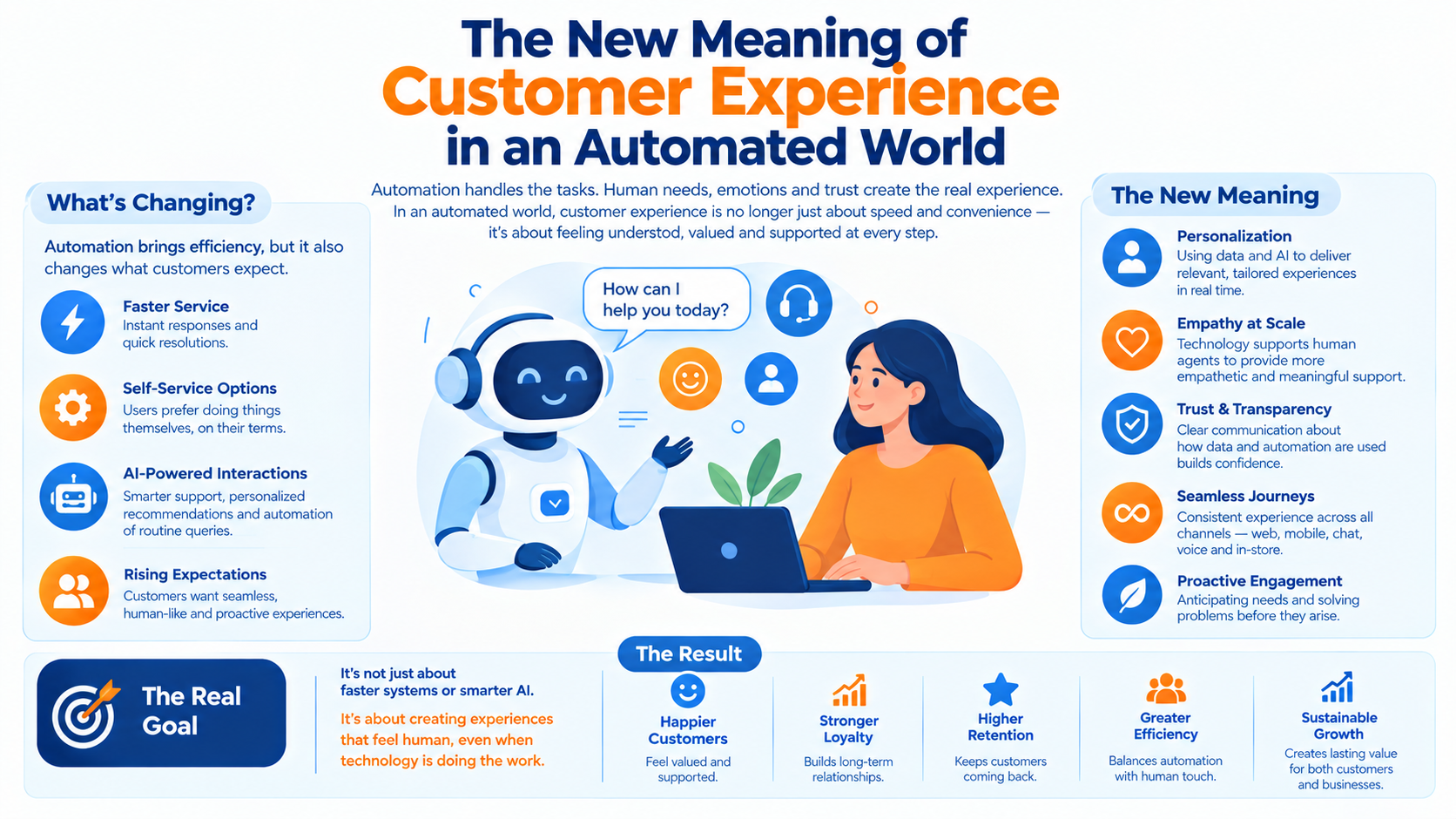
The Big Question
What happens when a customer's first interaction is with a chatbot that does not understand their problem? When a support workflow requires five automated steps before a human can be reached? When personalization is technically present but feels mechanical and unaware?
Automation has removed friction from many customer journeys. It has also introduced new kinds of friction the frustration of repeating information to a system, the helplessness of a process with no human escape, the coldness of an interaction that never acknowledges context.
The question is no longer whether to automate. It is what experience automation should deliver.
What Changed
The Economics of Interaction Changed
Human interaction is expensive. A support call costs orders of magnitude more than a self-service resolution. This economic reality has driven automation into every channel: chat, email, voice, and in-app.
The result is that customers now encounter automation first, and humans only sometimes.
Customer Expectations Changed
Customers now expect immediate response. They expect to resolve routine issues without waiting. They expect systems to remember their history and context.
Simultaneously, they expect a human to be available when the issue is complex, urgent, or emotional.
This combination immediacy plus accessibility is the core challenge of automated experience.
The Definition of Quality Changed
In a human-only world, quality was about the person: their knowledge, empathy, and responsiveness.
In an automated world, quality is about the system: does it understand what the customer is trying to do? Does it handle the common case well? Does it recognize when it cannot help? Does it hand off gracefully?
The system is now part of the experience, and its design determines how the customer feels.
The Four Dimensions of Automated Experience
Customer experience in an automated world rests on four dimensions.
1. Intent Understanding
The system must correctly identify what the customer is trying to accomplish.
Why it matters: A chatbot that misclassifies intent sends the customer down the wrong path. They must repeat themselves, restart, or abandon the attempt.
What good looks like:
-
The system asks clarifying questions when intent is ambiguous
-
It recognizes synonyms, typos, and informal phrasing
-
It uses context from previous interactions rather than starting fresh each time
What poor looks like: A rigid menu that forces the customer into predefined categories, regardless of what they actually need.
2. Response Quality
Once intent is understood, the system must respond usefully.
Why it matters: A response that is technically correct but unhelpful a link to a generic help page, a restatement of the problem, a refusal to engage degrades trust.
What good looks like:
-
The response addresses the specific question
-
It provides the next step, not just information
-
It is written in plain language
-
It acknowledges what the customer has already tried
What poor looks like: Generic answers, circular references, and responses that require the customer to figure out the next step themselves.
3. Failure Handling
Every automated system will encounter cases it cannot handle. How it fails determines the customer's experience.
Why it matters: A system that fails silently, loops endlessly, or traps the customer in an unresolvable process is worse than no automation.
What good looks like:
-
The system recognizes when it cannot help
-
It escalates to a human with full context
-
It does not make the customer repeat information already provided
-
It sets expectations about what happens next
What poor looks like: Infinite loops, dead ends, and escalations that lose context.
4. Human Accessibility
When automation cannot resolve an issue, the customer must be able to reach a human.
Why it matters: The absence of a human escape route transforms automation from convenience into a barrier.
What good looks like:
-
The path to a human is visible, not hidden
-
The customer does not have to navigate the entire automated flow first
-
The human receives full context
-
The wait is communicated honestly
What poor looks like: Hidden contact options, forced automation flows, and humans who start the conversation from scratch.
The Personalization Paradox
Automation enables personalization at scale. It also makes personalization feel mechanical when done poorly.
What makes personalization work:
-
It uses context the customer recognizes their history, their preferences, their previous issues
-
It adapts to the situation rather than applying rules blindly
-
It respects the customer's stated preferences rather than inferring them inaccurately
What makes personalization fail:
-
Recommendations based on data the customer did not knowingly share
-
Suggestions that ignore obvious context
-
Repetition of information the customer has already provided
-
Adaptation that feels intrusive rather than helpful
The distinction is whether personalization serves the customer's goal or the organization's metrics.
The Role of Human Judgment
Automation is excellent at handling routine cases at scale. It is poor at handling ambiguity, emotion, and edge cases.
Where human judgment matters most:
-
Situations involving significant consequence financial loss, health, safety
-
Situations involving emotion complaints, disputes, distress
-
Situations involving ambiguity cases that do not fit established patterns
-
Situations involving relationshipaccounts, partnerships, long-term customers
The design principle is not to automate everything. It is to automate what automation does well, and to preserve human judgment where it matters.
The practical question: For each interaction type, what is the cost of a wrong automated response versus the cost of a human interaction? The answer determines where automation belongs.
The Metrics That Matter
Traditional CX metrics—satisfaction scores, response times, resolution rates remain relevant. But automated experience requires additional measurement.
| Metric | What It Reveals |
|---|---|
| Containment rate | How often automation resolves the issue without escalation |
| Escalation rate | How often the customer needs a human |
| Escalation context retention | Whether the customer must repeat information |
| Loop rate | How often customers cycle through the same flow |
| Abandonment rate | How often customers give up |
| Time to resolution | Total time, including automation and human steps |
| First-contact resolution | Whether the issue was resolved in one interaction |
| Sentiment trend | How customers feel across the journey |
Containment rate alone is a misleading metric. A system can contain many interactions while leaving customers frustrated. The combination of containment and satisfaction reveals whether automation is actually working.
Design Principles for Automated Experience
Understand before responding. Do not act on ambiguous intent. Ask clarifying questions. It is better to ask than to guess wrong.
Preserve context across channels and steps. The customer should not have to repeat information because the system lost it.
Make the human path visible. Do not hide the escape route. A customer who knows help is available is more patient with automation.
Escalate with full context. The human should know what the customer has tried, what the system has determined, and what remains unresolved.
Fail gracefully. When the system cannot help, say so clearly and route appropriately.
Test with real cases. Automated flows designed on happy paths fail on real customer behavior. Test with the messy cases.
Measure experience, not just efficiency. Containment rate is not experience. Satisfaction, effort, and resolution are.
Implementation Roadmap
Phase 1: Assess (Weeks 1-2)
-
Map your automated customer journeys. Where does automation touch the customer?
-
Identify failure points. Where do customers loop, abandon, or escalate?
-
Measure current experience metrics across automation and human interactions.
Phase 2: Improve (Weeks 3-6)
-
Improve intent understanding with better classification and clarification.
-
Rewrite responses in plain language that addresses the specific question.
-
Build graceful failure paths with context-preserving escalation.
-
Make the human path visible without forcing the full automated flow first.
Phase 3: Operate (Weeks 7-10)
-
Track experience metrics alongside efficiency metrics.
-
Review escalation patterns to identify where automation fails.
-
Feed learnings back into the automated flows.
-
Reassess where human judgment should be preserved.
Frequently Asked Questions
Q1: Does automation reduce customer experience quality?
Not inherently. Poorly designed automation reduces quality. Well-designed automation improves it by resolving routine issues faster and freeing humans for complex cases.
Q2: What is the most common automation mistake?
Forcing customers through the full automated flow before allowing human contact. This transforms automation from convenience into a barrier.
Q3: How do I know when to automate and when to keep humans?
Compare the cost of a wrong automated response against the cost of a human interaction. Automate routine, low-consequence cases. Preserve humans for ambiguity, emotion, and high-consequence situations.
Q4: What is the most important metric?
First-contact resolution combined with satisfaction. Containment alone can be achieved by trapping customers, which is not experience improvement.
Q5: How should escalation work?
Escalation should preserve context the human should know what the customer tried, what the system determined, and what remains unresolved. The customer should not repeat themselves.
Q6: How can Innovative AI Solutions help?
We help organizations design automated customer experiences from intent understanding and response design to graceful escalation and experience measurement. Explore our services to see how we build customer-facing AI systems. Based in Delhi, serving clients across India.
Why Delhi is a Great Hub for CX Innovation
Delhi is emerging as a hub for customer experience and automation innovation, backed by a thriving IT services ecosystem and a large, diverse customer base. Indian enterprises serve customers across languages, literacy levels, and device capabilities which makes designing automated experiences that work for everyone both a challenge and a competitive advantage.
What We Offer at Innovative AI Solutions
-
CX Automation Strategy: We help you decide what to automate and what to preserve.
-
Conversational Design: We build intent understanding and response systems.
-
Escalation Design: We implement context-preserving handoff to human agents.
-
Experience Measurement: We track the metrics that reveal whether automation is working.
-
Continuous Improvement: We review escalation patterns and feed learnings back.
Final Thought
The shift is clear: from automating interactions to designing experiences. In an automated world, customer experience is determined by how well systems understand intent, respond usefully, fail gracefully, and preserve human judgment where it matters. Organizations that design for these dimensions will deliver automation that customers actually appreciate. Those that automate for efficiency alone will discover that containment rate is not the same as satisfaction.
Contact Us:
Phone: +91 7464 099 059 / +91 9689967356
Email: info@innovativeais.com
Address: 904, 9th floor Pearls Best Heights-I, Netaji Subhash Place, Delhi-110034
Website: https://innovativeais.com
About the Author
Abhishek Kumar
Founder & CEO, Innovative AI Solutions
5+ years building AI, cloud, and enterprise systems. Based in Delhi, serving clients across India.