The Big Question
What happens when your AI system has access to all the data in the world but still gives the wrong answer? When a model confidently recommends increasing marketing spend—completely missing the inventory stockout that's the actual problem? When the most advanced LLM on the market produces outputs that sound authoritative but are quietly wrong?
The Salesforce executive put it bluntly to a Calcutta audience: "We have seen many failed AI projects. The number one reason is not that they don't have data. It is because they don't have the context behind the data. The meaning becomes extremely important. Data is, at the end of the day, just bits and bytes. The context is the toughest piece to capture" .
The question isn't whether your organization has enough data. It's whether you have the context to make that data usable.
Data vs. Context: The Critical Distinction
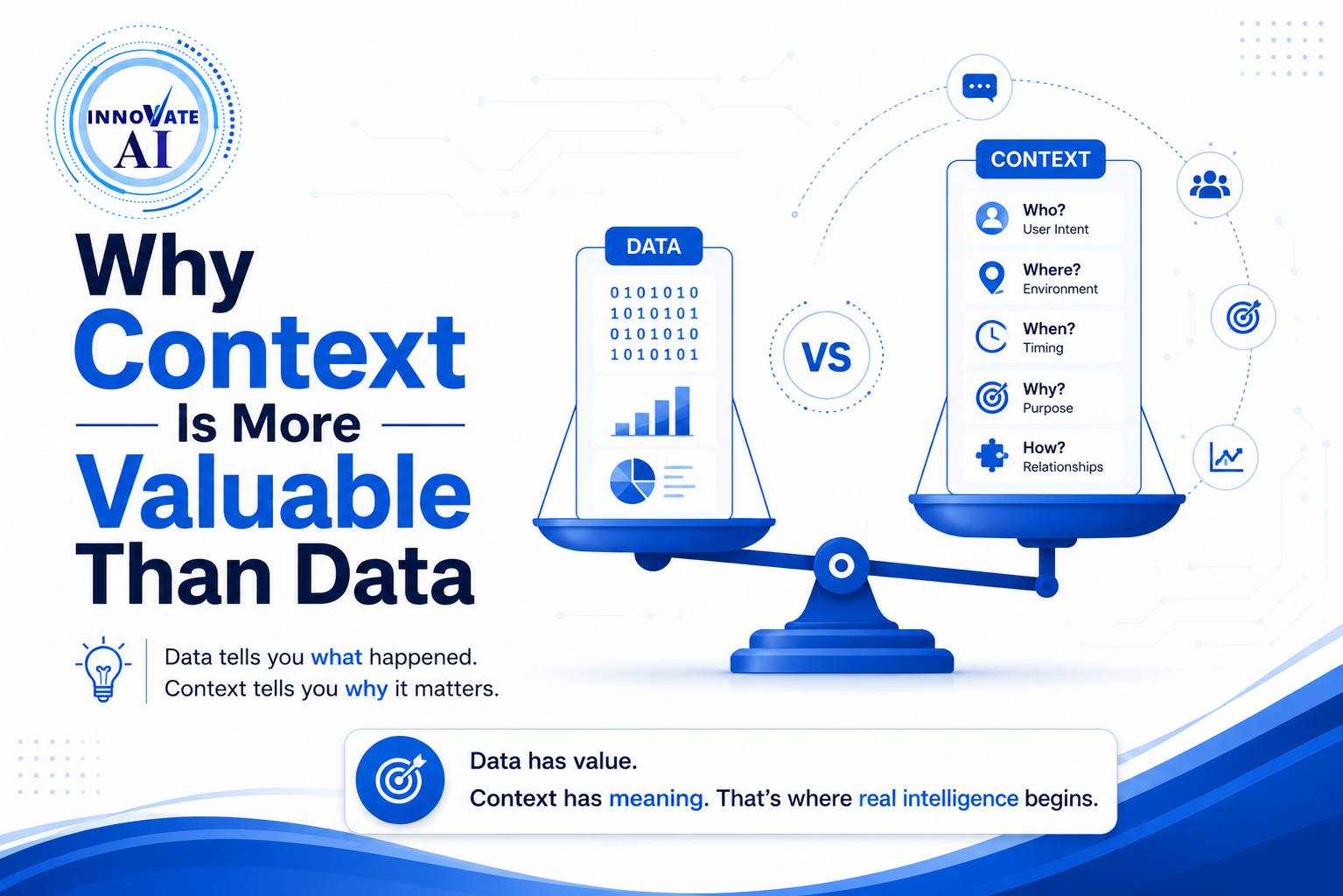
These two terms are often used interchangeably, but they describe fundamentally different things :
Data is raw information: records, events, measurements, transactions. A customer ID. A machine sensor reading. A sales figure.
Context is the layer of meaning that explains what that information means—how it connects to other things, why it matters, and what should happen as a result .
A Concrete Example
A customer record is data. Knowing that customer is a strategic account, renewed three weeks ago, currently has an unresolved service escalation, and is tied to a shipment delayed by four days—that's context .
A machine alert is data. Knowing that machine is on your highest-margin production line, has shown a recurring failure pattern over the last six months, and has no spare parts available for ten days—that's context .
The difference isn't trivial. An AI system with only the first piece of each pair will produce a generic response. An AI system with both pieces can tell you something operationally useful—and more importantly, something you can act on .
Why More Data Doesn't Fix This
The intuitive assumption is that AI quality improves with data volume. And to some extent, that's true for training large foundation models .
But in enterprise deployments, the problem is rarely that the model hasn't seen enough data. It's that the model doesn't understand the relationships between the data it has .
Consider a scenario: your AI system detects declining sales in a region and recommends increasing marketing spend. On the surface, that's a reasonable suggestion. But if the real cause is inventory stockouts driven by a logistics disruption—not weak demand then more marketing doesn't help. It drives demand you can't fulfill .
The model had access to the sales data. What it lacked was the connection between sales performance, inventory levels, logistics events, and supplier status. That connective layer is context .
The Needle in the Haystack Problem
Enterprises handle millions of documents—thousands of pages of disclosures, constant regulatory updates, and real-time market feeds. Hidden within that flood are the small but decisive pieces of information that are relevant for each particular query .
Even with context windows expanding to 1 million tokens, that's still only enough to hold the equivalent of a few long books far less than the entire corporate data estate. And researchers have discovered that size alone doesn't solve the problem. When you flood a model with too much data, it starts to lose focus .
What Enterprise AI Context Actually Consists Of
For enterprise AI to perform reliably, it needs to understand several categories of operational meaning :
| Component | What It Means |
|---|---|
| Entity Relationships | How things connect—customers to contracts, machines to components, orders to suppliers |
| Business Rules & Policies | What's allowed, what's restricted, what thresholds matter |
| Operational Priorities | What matters most—highest-margin line, critical service commitments |
| Historical Behavior | What's normal vs. abnormal for a given entity or process |
| Current State | What's changed recently, what's in progress, what's pending action |
When an AI system can answer questions with reference to all of these layers, it stops being a search tool and starts being something closer to operational intelligence .
The Consequences of Ignoring Context
The Bank That Sent Offers to Minors
Not long ago, a large bank rolled out an AI assistant to help identify customers eligible for a new premium credit card. Within days, the marketing team had sent eligibility offers to dozens of minors—children listed as beneficiaries on their parents' accounts .
Technically, the AI had done exactly what it was asked to do. It searched for "customers" who met certain criteria and returned a list. The problem was that it didn't understand what customer meant in context. It couldn't distinguish between an account holder and a beneficiary. It didn't know how internal eligibility rules were defined, or which policies constrained the action .
The data existed. The model worked. But the decision was wrong. This wasn't a failure of artificial intelligence. It was a failure of shared business context .
The Pharmaceutical Submission Error
A global pharmaceutical company deployed AI to accelerate safety reporting. The system could scan thousands of adverse event reports, identify relevant cases, and draft sections of regulatory submissions in hours instead of weeks. Then a submission was flagged during regulatory review. The AI had included an adverse event case that should have been excluded the patient was also taking a contraindicated medication, a detail buried in clinical notes. Technically, the event met the search criteria. But it violated reporting guidelines that required clinical context, not just pattern matching .
The limitation wasn't the model or the data access. It was context .
Context Engineering: The Enterprise Differentiator
Prompt vs. Context Engineering
When people talk about "getting good at AI," they often mean prompt engineering: phrasing a request so the model interprets it correctly. That's useful, but in enterprise settings it's like asking a brilliant analyst to answer a question without giving them the files they need .
| Prompt Engineering | Context Engineering | |
|---|---|---|
| Controls | Style | Substance |
| What it changes | How you ask | What the model sees |
| Example | "Summarize as a risk analyst" | Provide the correct transcript, latest financials, expert commentary |
The Context Layer
What enterprises need now is not simply more data infrastructure. They need a data foundation that has a shared, explicit representation of how the business works . That representation is the context layer .
The context layer captures :
-
Core business concepts and how they relate
-
Critical reference data and shared terminology
-
Metadata describing structured and unstructured assets
-
Business logic, policies, and guardrails expressed in machine-readable form
It connects what data means, where it lives, and how it should be used.
The Financial Services Example
Financial institutions collect massive volumes of information—transaction records, market events, customer documents, system logs—but data volume alone creates no value. Structure and context turn raw data into fuel for business decisions and AI use cases .
CME Group processes 30 billion market events daily. On a single Friday, they captured 5.5 billion market data events and 2.8 billion order entry events. They store 20 years of these snapshots .
"We're not in the business of just predicting, we're not in the business of forecasting," explained CME's CIO. "We're in the business of identifying worst-case situations for a given portfolio" .
The value comes from adding historical context—understanding how markets performed during the 1980s stagflation, then applying that pattern to today's environment .
Three Principles for Refining Data
The pattern across CME, KeyBank, and BNY points to three essential practices :
1. Start with what your data represents. Before CME could model risk scenarios, they needed to understand what 30 billion daily market events actually meant for portfolio behavior under different conditions.
2. Connect data to business outcomes from day one. KeyBank learned this lesson directly: data initiatives that exist in isolation fail. When their commercial banking team wanted faster loan approvals, they started with the business goal.
3. Build governance that adds value, not just restrictions. BNY's review board process could slow teams down. Instead, it accelerates them. Governance can become a competitive advantage when it provides context about data provenance, usage rights, and appropriate applications.
Why This Matters for Generative AI
Large language models are fluent. They can summarize, draft, and converse in ways that feel remarkably capable. In enterprise settings, fluency isn't enough .
When an employee asks an AI assistant which version of a contract is currently valid, or which inventory number is accurate as of today, or which incident requires immediate escalation—they need answers grounded in operational reality, not answers that are merely well-phrased .
The failure mode is subtle and damaging: generative AI with weak enterprise context produces responses that sound authoritative and turn out to be wrong. After employees encounter this a few times, they stop using the tool. The investment gets written off. And the organization concludes that AI "isn't ready"—when the real issue was that the architecture wasn't ready .
Implementation Roadmap
Phase 1: Foundation (Weeks 1-4)
-
Audit your data estate: What data do you have? Where is context missing? What relationships are implicit rather than explicit?
-
Identify high-value knowledge gaps: Which decisions are currently made without adequate context? Where are the most costly failures?
-
Define core business concepts: What are the entities, relationships, and rules that matter most to your business?
-
Establish governance requirements: Who owns what data? What are the compliance constraints?
Phase 2: Build the Context Layer (Weeks 5-8)
-
Deploy metadata management: Create a catalog that documents data meaning, ownership, and lineage
-
Build entity relationships: Make explicit how business objects connect—customers to contracts to orders to shipments
-
Express business logic in machine-readable form: Turn policies and rules into enforceable constraints
-
Connect data to business outcomes: Ensure every data initiative has a line of sight into value
Phase 3: Operationalize (Weeks 9-12+)
-
Enable runtime access to context: Make metadata available to AI agents at decision time via MCP or similar
-
Measure impact on outcomes: Track decision quality, time saved, and trust metrics
-
Treat context as living: The context layer must evolve with the business
Frequently Asked Questions
Q1: What's the difference between data and context?
Data is raw information—records, events, measurements. Context is the layer of meaning that explains what that information means, how it connects to other things, why it matters, and what should happen as a result .
Q2: Why do AI projects fail due to context?
The number one reason is not lack of data. It's lack of context behind the data. Organizations invest in bigger data lakes, more integrations, better pipelines—and the same problems persist .
Q3: What is context engineering?
The discipline of structuring, prioritizing, and supplying the model with the right information in the right way at the right moment. It controls substance, not just style .
Q4: What is the context layer?
A unified representation of how the business works—capturing core concepts, reference data, metadata, and business logic in machine-readable form .
Q5: How can Innovative AI Solutions help?
We help organizations design, build, and operationalize context layers that make AI actually work in production from metadata management and entity modeling to governance frameworks and runtime context delivery. Based in Delhi, serving clients across India.
Why Delhi is a Great Hub for Context Innovation
Delhi is emerging as a hub for data governance and AI innovation, backed by a thriving tech ecosystem and government support for digital transformation. As Indian enterprises move from AI pilots to production, the need for robust context engineering is becoming critical. Organizations that build context layers now will be well-positioned to lead in India's AI-driven economy.
What We Offer at Innovative AI Solutions
-
Context Strategy: We help you assess your data estate and design a context architecture
-
Metadata Management: We help you build catalogs that document data meaning, ownership, and lineage
-
Entity Modeling: We help you make explicit how business objects connect
-
Governance Frameworks: We help you establish policies, permissions, and audit trails
-
Runtime Context Delivery: We help you make context available to AI agents at decision time
Final Thought
The verdict is clear. Data tells AI what exists. Context tells AI what it means, how things connect, and what action makes sense .
As the Salesforce executive concluded: "We have to be able to bring all of that consumer behavior over the past many years, digest all of that, hyper-personalize it, and be able to offer that to the consumer in real-time. We are talking less than 300 milliseconds" .
The organizations that gain durable advantage from AI will be those whose data is structured, connected, and operationally meaningful—not just large .
Contact Us:
Phone: +91 7464 099 059 / +91 9689967356
Email: info@innovativeais.com
Address: Netaji Subhash Place, Pitampura, Delhi – 110034
Website: https://innovativeais.com
About the Author
Abhishek Kumar
Founder & CEO, Innovative AI Solutions
5+ years building AI and data systems for enterprises. Based in Delhi, serving clients across India.