The Big Question
What happens when a logistics company's competitive advantage is its routing algorithm rather than its fleet? When a manufacturer's margin depends on its predictive maintenance platform rather than its machinery? When a retailer's growth comes from its inventory optimization system rather than its store locations?
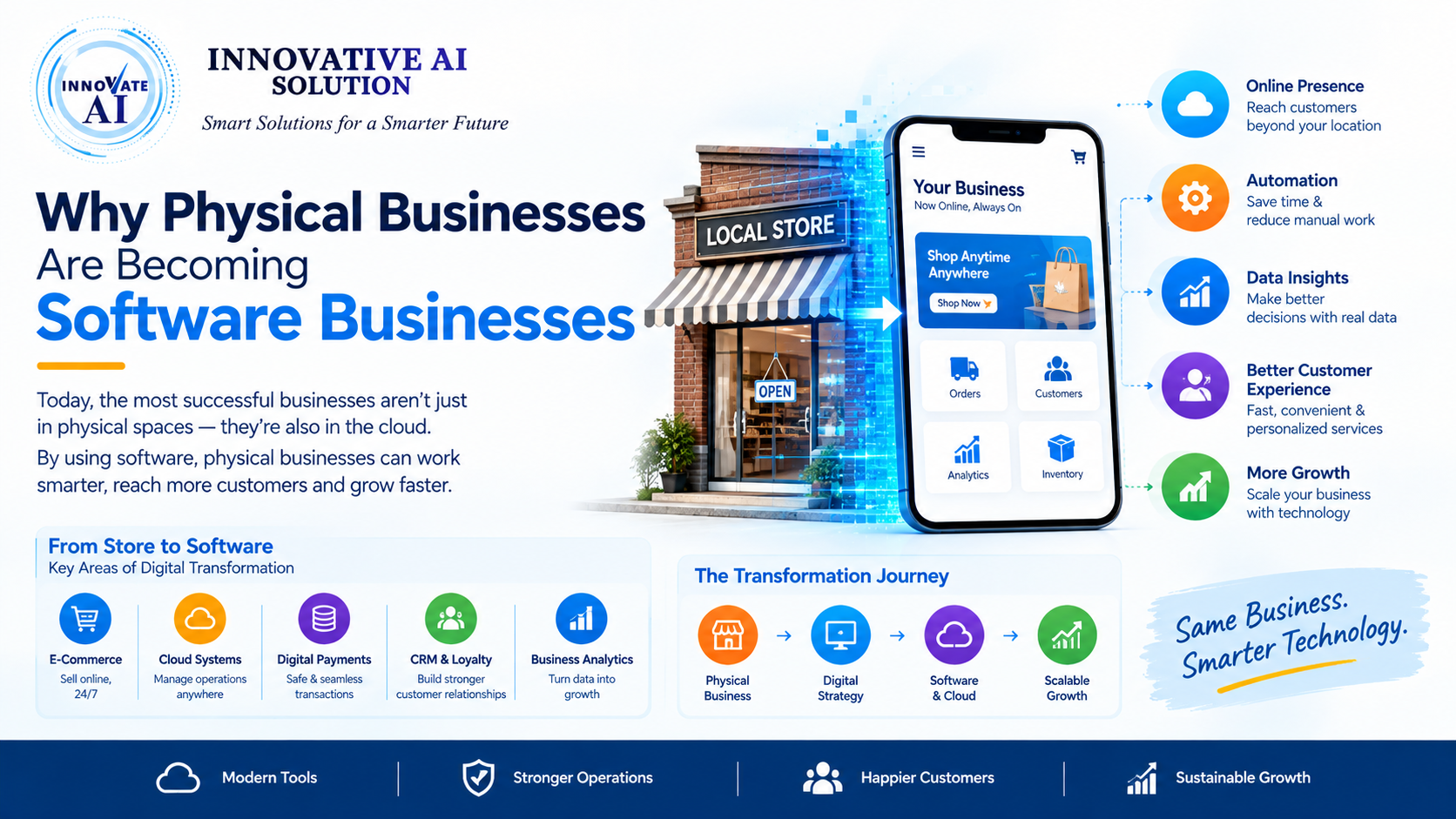
This is the reality across industries. Physical businesses are becoming software businesses because software has become the layer where operational decisions are made.
What It Actually Means
The phrase is often misunderstood. It does not mean every company writes its own operating system. It means three specific things:
1. Software coordinates the physical operation. Scheduling, routing, inventory, pricing, staffing, and maintenance are increasingly determined by software rather than by human judgment and paper processes.
2. Software captures operational knowledge. Institutional knowledge that once lived in experienced employees now lives in systems encoded as rules, models, and data.
3. Software enables differentiation. Two companies with similar physical assets perform differently because one has better software.
When these three conditions hold, a physical business is a software business regardless of what it sells.
Why This Shift Is Structural
Physical Assets Are Increasingly Commoditized
Machinery, vehicles, warehouses, and retail space can be bought by anyone with capital. Access to physical assets is no longer a durable advantage. What differs is how efficiently those assets are used.
Operational Complexity Has Outgrown Manual Coordination
Modern supply chains, multi-channel retail, and distributed manufacturing involve thousands of variables changing continuously. Human coordination at this scale is no longer feasible. Software does not merely assist it is the mechanism by which coordination happens at all.
Sensors Made Operations Visible
Every machine, vehicle, shipment, and shelf can now report its state continuously. This created a torrent of operational data that only software can interpret and act upon.
The Cost of Building Software Fell
Cloud platforms, managed services, and AI APIs dramatically reduced the cost of building and operating software. What required a large engineering organization a decade ago is now achievable by a much smaller team.
Software Compounds
Unlike physical assets, software improves with use. Every interaction generates data that improves the next decision. This creates a flywheel that favors organizations that invest early and consistently.
What This Looks Like in Practice
Logistics
Logistics companies once competed on fleet size and network coverage. Today they compete on routing intelligence, demand prediction, and real-time visibility. The physical trucks remain necessary, but the differentiator is the software that decides where they go.
Manufacturing
Manufacturers once competed on production capacity and cost. Today they compete on yield optimization, predictive maintenance, and quality control all driven by software analyzing data from instrumented production lines.
Retail
Retailers once competed on location and assortment. Today they compete on demand forecasting, inventory placement, personalization, and fulfillment speed. The store and the warehouse remain, but the software determines what is stocked, where, and at what price.
Healthcare
Healthcare providers once competed on facilities and physician reputation. Today they compete on outcomes, patient experience, and operational efficiency increasingly determined by clinical software, scheduling systems, and analytics.
Energy
Energy companies once competed on generation capacity. Today they compete on grid optimization, demand forecasting, and distributed resource management all software-driven.
The pattern is consistent: the physical layer remains, but the decision layer has moved into software.
The Organizational Consequences
Becoming a software business is not only a technical change. It requires organizational shifts that many physical businesses find difficult.
Engineering Becomes a Core Function
In a physical business, IT is often a support function. In a software business, engineering is a core capability that determines competitive position. This changes hiring, compensation, organizational structure, and executive attention.
Product Thinking Replaces Project Thinking
Physical businesses often think in projects install this system, complete that upgrade. Software businesses think in products continuously evolving systems with owners, roadmaps, and users. The shift from project to product is one of the hardest transitions.
Data Becomes an Asset to Manage
Data is not a byproduct. It is an asset that must be collected deliberately, governed carefully, and used continuously. This requires ownership, quality practices, and infrastructure.
Speed Becomes a Competitive Variable
Software businesses release continuously. Physical businesses often operate on quarterly or annual cycles. Closing this gap requires changes to how decisions are made, how changes are tested, and how risk is managed.
Operational Knowledge Must Be Encoded
When knowledge lives in experienced employees, it leaves when they do. Software businesses encode operational knowledge into systems rules, models, and automated workflows so that it persists and improves.
The Common Objections
"We are not a technology company."
You do not have to be. But if your operational decisions are made by software, then your ability to build and improve that software determines your competitive position whether or not you call yourself a technology company.
"We tried digital transformation and it failed."
Most transformation efforts fail because they are framed as technology projects rather than operational changes. The successful ones start with a specific operational problem, solve it with software, and expand from there.
"Our business is relationship-driven."
Relationships remain valuable. But the operational execution behind those relationships delivery reliability, pricing accuracy, service quality increasingly depends on software.
"We do not have the talent."
Talent is a real constraint, but it is solvable through hiring, partnerships, and managed services. The more common constraint is organizational willingness to treat engineering as core.
How to Make the Transition
Start With a Specific Operational Problem
Do not begin with a platform strategy. Begin with a decision that is currently made poorly inventory allocation, maintenance scheduling, route planning and build software that makes it better.
Measure the Decision, Not the Software
The goal is not to deploy software. The goal is to improve a decision. Measure the outcome: cost per delivery, downtime per machine, inventory turns per store.
Build the Data Foundation
Most operational problems cannot be solved without data that is currently fragmented or missing. Instrument the operation before attempting to optimize it.
Encode Knowledge Deliberately
Identify the operational knowledge that currently lives in people the rules of thumb, the exception handling, the judgment calls and encode it into systems. This is how knowledge becomes durable.
Treat Engineering as a Core Capability
Hire engineers, give them ownership of operational outcomes, and include them in operational decisions. Software built in isolation from operations rarely solves the right problem.
Expand Incrementally
Do not attempt to rebuild everything at once. Solve one problem, prove value, and expand. The compounding advantage comes from many small improvements, not one large transformation.
Implementation Roadmap
Phase 1: Identify (Weeks 1-4)
-
Map the decisions that determine operational performance.
-
Identify which decisions are made poorly due to missing data, slow processes, or inconsistent judgment.
-
Select one decision as the initial target.
Phase 2: Instrument and Build (Weeks 5-10)
-
Instrument the operation to capture the data required.
-
Build the software that improves the decision.
-
Measure the outcome against a baseline.
Phase 3: Expand (Weeks 11+)
-
Encode operational knowledge into systems.
-
Build the data foundation that supports multiple decisions.
-
Expand to adjacent decisions where the foundation applies.
-
Treat engineering as core by giving teams ownership of operational outcomes.
Frequently Asked Questions
Q1: Does every physical business need to become a software business?
Every physical business whose operational decisions are increasingly made by software is, functionally, a software business whether or not it recognizes it. The question is not whether to become one, but whether you will be good at it.
Q2: What is the difference between digital transformation and this shift?
Digital transformation often means deploying technology to existing processes. This shift means changing how operational decisions are made and treating software as the mechanism for that change.
Q3: How do I start?
Start with one operational decision that is made poorly today. Instrument it, build software to improve it, and measure the outcome. Expand from there.
Q4: Do I need to build everything in-house?
No. Cloud platforms, managed services, and AI APIs make it possible to build capability without building everything. The key is owning the decisions and the data, not necessarily every component.
Q5: What is the biggest obstacle?
Organizational, not technical. Treating engineering as a core function, shifting from project to product thinking, and giving software teams ownership of operational outcomes are the hardest changes.
Q6: How can Innovative AI Solutions help?
We help organizations identify high-value operational decisions, build the software and data foundations to improve them, and make the organizational shift toward treating engineering as core. Based in Delhi, serving clients across India.
Why Delhi is a Great Hub for This Transition
Delhi is a hub for both physical industry and technology talent manufacturing, logistics, retail, healthcare, and financial services alongside one of the largest concentrations of software engineers in the world. This combination makes the region uniquely positioned to lead the convergence of physical operations and software capability, particularly as Indian enterprises modernize at scale.
What We Offer at Innovative AI Solutions
-
Operational Decision Mapping: We identify the decisions that determine performance and where software can improve them.
-
Data Foundation Design: We build the instrumentation and data infrastructure that operational software requires.
-
Software Development: We build the systems that improve operational decisions.
-
Organizational Enablement: We help you shift from project to product thinking and treat engineering as core.
-
AI Integration: We build the models and automation that turn operational data into better decisions.
Final Thought
The shift is clear: from competing on what you own to competing on how well you decide. Physical businesses are becoming software businesses because software is where operational decisions are made. The organizations that recognize this and invest accordingly will compound their advantage. Those that treat software as a support function will find themselves outmaneuvered by competitors with the same equipment and better decisions.
Contact Us:
Phone: +91 7464 099 059 / +91 9689967356
Email: info@innovativeais.com
Address: 904, 9th floor Pearls Best Heights-I, Netaji Subhash Place, Delhi-110034
Website: https://innovativeais.com
About the Author
Abhishek Kumar
Founder & CEO, Innovative AI Solutions
5+ years building AI, cloud, and enterprise systems. Based in Delhi, serving clients across India.